7 Italian Hand Gestures Explained
Learn the meaning of seven famous Italian hand gestures and discover how Italians communicate beyond words.
You are sitting in a café in Rome. At the next table, two friends are talking. Their voices are calm, but their hands never stop moving.
You may not understand every word they are saying, but their expressions and gestures already tell you a large part of the story.
In Italy, gestures can express surprise, admiration, uncertainty, irritation or indifference. Sometimes one movement replaces an entire sentence.
Why do Italians use so many gestures?
Gestures add emotion and emphasis to spoken language. They can make a question stronger, a reaction warmer or a disagreement clearer.
Not every Italian gestures in the same way or with the same frequency. Habits vary according to personality, age and region. However, many gestures are understood throughout Italy and form part of everyday communication.
Seven common Italian gestures
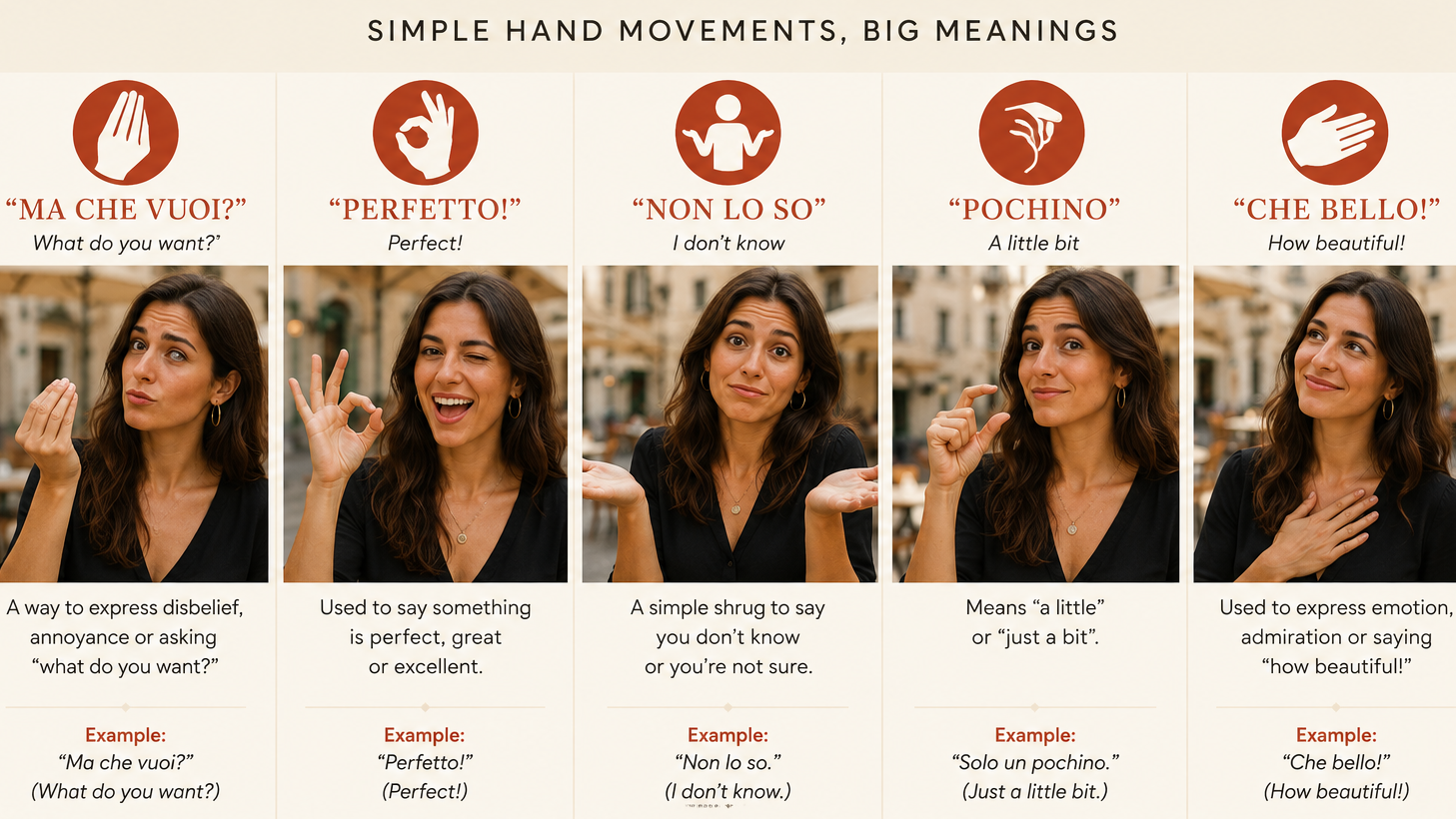
1. Ma che vuoi?
The fingertips are joined together and the hand moves slightly up and down. It can express confusion, disbelief or irritation. Depending on the context, it may mean: “What do you want?”, “What are you saying?” or “What is the problem?”
What do you want?2. Perfetto!
The thumb and index finger form a circle. This gesture shows that something is excellent, correct or exactly as expected.
Perfect!3. Non lo so
The shoulders are raised and the palms are opened. It can communicate uncertainty or lack of knowledge: “I don’t know”, “I’m not sure” or “What can I do?”
I don’t know.4. Solo un pochino
The thumb and index finger are held close together to indicate a very small quantity. Italians use it when talking about food, time, money, distance or anything small.
Just a little bit.5. Che bello!
A hand placed over the chest can express admiration, affection, emotion or gratitude. It is often accompanied by a warm smile.
How beautiful!6. Vai via, smamma!
The hands move as if sending someone away. It is an informal gesture and can sound rude when used seriously. Among friends, it may also be playful or ironic.
Go away!7. Non mi interessa
The hand moves outward from under the chin. It communicates indifference or dismissal: “I’m not interested”, “I don’t care” or “It doesn’t matter to me”.
I’m not interested.Hundreds of gestures have been documented across Italy. Some are understood almost everywhere, while others are strongly connected to particular regions.
Can the same gesture have different meanings?
Yes. Facial expression, tone of voice, movement and context are all important.
The same gesture may appear angry during an argument, playful between friends or ironic in a relaxed conversation.
Learning Italian beyond words
Learning Italian is not only about vocabulary and grammar. It also means observing how people react, move and express emotion.
Understanding Italian hand gestures helps you follow conversations more naturally and recognise the cultural meaning behind everyday communication.
Learn Italian through real culture
At My Italian Space, learning Italian means discovering not only the language, but also the gestures, traditions and everyday habits that make communication come alive.
Book your live Italian lesson